
Index
Maja Warlich

Young Research Group: Geographies of Digital Infrastructures
I am part of the young research group “Geographies of Digital Infrastructures”. Our project’s topic is “Resiliance of Digital Infrastructure – Geopolitical Conflicts Surrounding Internet Routing”, see NG Geographien digitaler Infrastrukturen for more information.
PhD project in Computer Science
My interdisciplinary PhD project is located in the intersection of Computer Science (Internet measurement, IT-security) and Geography (digital infrastructure, geopolitics). I analyse the impact that physical Internet infrastructure such as submarine fiber-optic cables, data centers, and interconnection facilities have on digital interconnection between networks, and what role economic strategies of private and state actors as well as geopolitical contexts play in data routing decisions.
Within my research, I use and extend on common Internet measurements techniques. Public, historic databases aid me in tracing routing decisions over time, which are partially reflected in traceroutes and Border Gateway Protocol (BGP) routing tables. By focussing on select pieces of infrastructure, I investigate the network topology arround it to understand the interplay between phyiscal and digital interconnection.
EllaLink serves as a case study for my PhD project. As the first – and, to date, only – fibre-optic cable carrying IP traffic between Europe and South America, it offers a chance to study changes in network proximity between two continents in as isolated a system as is possible within the incredibly interconnected global Internet.
Another aim of my PhD project is to create a threat model for state actors wanting secure, sovereign, and resillient digital connectivity even in times of crisis. As I have shown in my Master thesis “Towards a Threat Model for Satellite Internet in War Zones – Insights from the Russia-Ukraine War”, classic threat models are perfected for systems on a much smaller scale than a whole country’s connectivity, and ignore that sometimes, the security goals of a system’s owner or operator aren’t congruent with a system’s user. Yet, state actors often rely on private and even foreign companies, tech giants, and sometimes individuals to secure connectivity for their people. With how ciritcal global, fast, and easily accessible connectivity is in times of peace as well as conflict, state actors must be equipped with the tools to to ascertain, analyze, prevent, and mitigate threats towards it – a threat model for Internet connectivity from a state actor’s perspective.
Vorträge
- Spatial Politics of Internet Infrastructures: The Promise and Unintended Effects of the EllaLink Submarine Cable; Jahrestagung des AK Digitale Geographie 6.-7.11.2025 in Frankfurt am Main
Publikationen
- Warlich, Maja (2025): Reeling in Secrets: A Deep Dive into FinFisher Spyware. FIfF-Kommunikation, 2/2025, S. 7-12
Since 2025
Working Group “Resilienz digitaler Infrastrukturen – Geopolitische Konflikte um Internet-Routing”, NG Geographien digitaler Infrastrukturen, FAU
2022 – 2025
M.Sc. Computer Science – “Towards a Threat Model for Satellite Internet in War Zones – Insights from the Russia-Ukraine War”, Department of Computer Science, FAU
2024 – 2025
Head Delegate – “FAU Model United Nations (FAUMUN) Seminar”, Department of Public and International Law, FAU
2018 – 2024
Part-Time Employee and Working Student – “Document & Configuration Management Professional”, Research and Development, Siemens AG
2017 – 2022
B.Sc. Computational Engineering – “Implementation of Communication Schemes for the LB Method using Different Data Structures through Meta-Programming Techniques”, Department of Computer Science, FAU
Samuel Cook
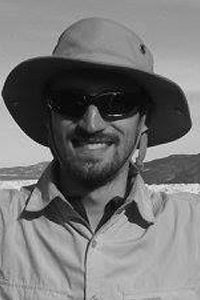
DELIGHT Junior Research Group Leader, FAU, Erlangen-Nüremberg
2024-2030
PI of DELIGHT Framework project, seeking to couple a suite of models to accurately model the entire hydrological system of glacierised catchments (all processes from precipitation through glacier mass balance and hydrology to downstream hydrology) using machine learning to overcome computational bottlenecks. Early-career Postdoctoral Fellow, Faculté de Géosciences et l’Environnement, Université de Lausanne
2022-2024
Used the IGM deep-learning-driven glacier-flow-and-inversion model to invert for ice thickness at all the world’s glaciers outside the ice sheets, allowing us to better constrain sea-level rise (important for the 10% of the world’s population that live near the coast) and the evolution of water resources and water-related catchments in glacierised catchments (home to a third of the world’s population). Further expanded simulation-design, big-data-processing and data-analysis skills. Postdoctoral researcher, Institut des Géosciences de l’Environnement, Université Grenoble Alpes
2020-2022
Worked on the project ANR-Magic, implementing data assimilation scheme in Elmer/Ice in 2D and 3D to improve the model’s ability to take into account observations to refine its own predictions and state. Further improved programming and model coupling skills. PhD Polar Studies, Selwyn College, University of Cambridge
2016-2020
Thesis title: Connect Store: A fully coupled 3D model of ice flow, calving, subglacial hydrology and ice-ocean interactions applied to Store Glacier, Greenland. Awarded 28.11.20. Funded by NERC. Supervised by Dr Poul Christoffersen. Developed a fully coupled numerical model of a tidewater glacier system including ice flow, calving, subglacial hydrology and proglacial meltwater plumes, within the finite-element, 3D, full-Stokes Elmer/Ice modelling suite in order to improve understanding and prediction of the behaviour of these complex systems. Model applied to Store Glacier, west Greenland. Validated the model with reference to a record of calving events in July 2017 at Store Glacier, extracted from a three-week terrestrial radar interferometer record gathered on a month-long field campaign.
- Cook, S. J., Jouvet, G., Millan, R., Rabatel, A., Zekollari, H., and Dussaillant, I.: Committed Ice Loss in the European Alps Until 2050 Using a Deep-Learning-Aided 3D Ice-Flow Model With Data Assimilation, Geophysical Research Letters, 50(23), e2023GL105029. https://doi.org/10.1029/2023GL105029
- Cook, S. J., Christoffersen, P., and Wheel, I.: Coupled 3D full-Stokes modelling of tidewater glaciers, Annals of Glaciology, 1-4. doi:10.1017/aog.2023.4, 2023.
- Cook, S.J., Gillet-Chaulet, F., and Fürst, J.: Robust reconstruction of glacier beds using transient 2D assimilation with Stokes, Journal of Glaciology, 1-10, https://doi.org/10.1017/jog.2023.26, 2023.
- Cook, S. J., Christoffersen, P., and Todd, J.: Fully-coupled 3D modelling of ice flow, calving, subglacial hydrology and calving-front melting at Store Glacier, West Greenland, Journal of Glaciology, 1-17, https://doi.org/10.1017/jog.2021.109, 2021
- Cook, S. J., Christoffersen, P., Truffer, M., Chudley, T. R., and Abellán, A.: Calving of a Large Greenlandic Tidewater Glacier has Complex Links to Meltwater Plumes and Mélange. Journal of Geophysical Research : Earth Surface, 126(4), e2020JF006051. https://doi.org/10.1029/2020JF006051, 2021
- Cook, S. J., Christoffersen, P., Todd, J., Slater, D., and Chauché, N.: Coupled modelling of subglacial hydrology and calving-front melting at Store Glacier, West Greenland, The Cryosphere, 14, 905-924, https://doi.org/10.5194/tc-14-905-2020, 2020.
- Benn, D.I., Todd, J.A., Luckman, A., Bevan, S.L., Chudley, T.R., Åström, J., Zwinger, T., Cook, S.J., and Christoffersen, P.: Controls on calving at a large Greenland tidewater glacier: stress regime, self-organised criticality and the crevasse-depth calving law, Journal of Glaciology, 1–16. https://doi.org/10.1017/jog.2023.81, 2023
- Law, R., Christoffersen, P., Mackie, E., Cook, S.J., Haseloff, M., and Gagliardini, O.: Hybrid basal motion of the Greenland Ice Sheet, Science Advances, 9(6), https://doi.org/10.1126/sciadv.abq5180, 2023.
- Derkacheva, A., Gillet-Chaulet, F., Mouginot, J., Jager, E., Maier, N., and Cook, S. J.: Seasonal evolution of basal environment conditions of Russell sector, West Greenland, inverted from satellite observation of surface flow, The Cryosphere, 15, 5675–5704, https://doi.org/10.5194/tc-15-5675-2021, 2021.
I teach some of the Masters-level courses in the department in both semesters. For what’s currently on offer, please check the relevant course pages or in CAMPO.
My research focuses on modelling contemporary glaciers at a variety of scales with a variety of methods, from explicit physical modelling to deep learning. I am particularly interested in glacial processes related to hydrology and those occurring at tidewater glaciers. For more information on my current research project, please see the group page.
I believe I am also technically the world expert on glaciation in Middle-earth, mainly because no one else has bothered thinking about it to the best of my knowledge.
Manuel Saigger

since 2022: Doctoral Canditate in the Climate System Research Group, FAU Erlangen-Nürnberg
2017 – 2021: M.Sc. Atmospheric Science at the Institute of Atmospheric and Cryospheric Sciences, University of Innsbruck
2014 – 2017: B.Sc. Atmospheric Science at the Institute of Atmospheric and Cryospheric Sciences, University of Innsbruck
Saigger, M., Sauter, T., Schmid, C., Collier, E., Goger, B., Kaser, G., et al.: A drifting and blowing snow scheme in the weather research and forecasting model. Journal of Advances in Modeling Earth Systems, 16, e2023MS004007. https://doi.org/10.1029/ 2023MS004007, 2024.
Voordendag, A., Goger, B., Prinz, R., Sauter, T., Mölg, T., Saigger, M., and Kaser, G.: A novel framework to investigate wind-driven snow redistribution over an Alpine glacier: combination of high-resolution terrestrial laser scans and large-eddy simulations, The Cryosphere, 18, 849–868, https://doi.org/10.5194/tc-18-849-2024, 2024.
Saigger, M. and Gohm, A.: Is it north or west foehn? A Lagrangian analysis of Penetration and Interruption of Alpine Foehn intensive observation period 1 (PIANO IOP 1), Weather Clim. Dynam., 3, 279–303, https://doi.org/10.5194/wcd-3-279-2022, 2022.
t.b.a.
IDP MOCCA (Measuring and Modeling of Mountain Glaciers and Ice Caps in a Changing Climate), Subproject 3.1: Snow drift and internal refreezing in glacier mass balance models
t.b.a.
Elena Kropač

Since 02/2021 Research associate/doctoral candidate in AG Mölg, FAU Erlangen-Nürnberg
04/2017 – 07/2019 MSc Climate and Environmental Sciences, FAU Erlangen-Nürnberg
10/2013 – 09/2016 BSc Physische Geographie, FAU Erlangen-Nürnberg
Kropač, E., Mölg, T., and Cullen, N.J. (2025): From sea to summit: Investigating the explicit role of SST increase for regional and high-altitude climates in New Zealand. Journal of Geophysical Research: Atmospheres, 130(15): e2025JD043572. https://doi.org/10.1029/2025JD043572
Kropač, E., Mölg, T., and Cullen, N.J. (2024): A new, high‐resolution atmospheric dataset for southern New Zealand, 2005–2020. Geoscience Data Journal, 4(11): 873–895. https://doi.org/10.1002/gdj3.263
Kropač, E., Mölg, T., Cullen, N.J., Collier, E., Pickler, C., and Turton, J.V. (2021): A detailed, multi-scale assessment of an atmospheric river event and its impact on extreme glacier melt in the Southern Alps of New Zealand. Journal of Geophysical Research: Atmospheres, 126(9): e2020JD034217. https://doi.org/10.1029/2020JD034217
Mölg, T., Hardy, D.R., Collier, E., Kropač, E., Schmid, C., Cullen, N.J., Kaser, G., Prinz, R., and Winkler, M. (2020): Mesoscale atmospheric circulation controls of local meteorological elevation gradients on Kersten Glacier near Kilimanjaro summit. Earth System Dynamics, 11(3): 653–672. https://doi.org/10.5194/esd-11-653-2020
Project (DFG-funded):
NZ-PROXY: Das Potenzial von corallinen Algen als Indikator des Klimas in der Südlichen Hemisphäre und für die Evaluierung von globalen Klimamodellen: eine Fallstudie zu Neuseeland -> More information
Research focus:
- Regional atmospheric modelling using WRF (Weather Research and Forecasting model)
- Mesoscale atmospheric processes in mountainous regions
- High-elevation climate and atmosphere–glacier interactions
- New Zealand climate
- Climate proxies
Josephine Brandenburg

Since May 2025
Funded as part of the ‘Graduate Centre for Doctoral Students’ of the Bavarian Research Institute for Digital Transformation (bidt)
Since January 2025
Doctoral student in the junior research group ‘Resilience of Digital Infrastructures – Geopolitical Conflicts around Internet Routing’ (BMFTR project), Working Group on Geographies of Digital Infrastructures, FAU Erlangen-Nuremberg
2021-2024
Master of Arts Cultural Geography: ‘Legitimacy of European border protection – The European border protection agency Frontex in crisis’, Institute of Geography, FAU Erlangen-Nuremberg
2017-2021
BA Cultural Geography/Political Science: “Climate refuge to Europe? A discourse-theoretical analysis of negotiations and practices of the EU Commission”, Institute of Geography, FAU Erlangen-Nuremberg
Since May 2025
Funded as part of the ‘Graduate Centre for Doctoral Students’ of the Bavarian Research Institute for Digital Transformation (bidt)
Since January 2025
Doctoral student in the junior research group ‘Resilience of Digital Infrastructures – Geopolitical Conflicts around Internet Routing’ (BMFTR project), Working Group on Geographies of Digital Infrastructures, FAU Erlangen-Nuremberg
2021-2024
Master of Arts Cultural Geography: ‘Legitimacy of European border protection – The European border protection agency Frontex in crisis’, Institute of Geography, FAU Erlangen-Nuremberg
2017-2021
BA Cultural Geography/Political Science: “Climate refuge to Europe? A discourse-theoretical analysis of negotiations and practices of the EU Commission”, Institute of Geography, FAU Erlangen-Nuremberg
Since May 2025
Funded as part of the ‘Graduate Centre for Doctoral Students’ of the Bavarian Research Institute for Digital Transformation (bidt)
Since January 2025
Doctoral student in the junior research group ‘Resilience of Digital Infrastructures – Geopolitical Conflicts around Internet Routing’ (BMFTR project), Working Group on Geographies of Digital Infrastructures, FAU Erlangen-Nuremberg
2021-2024
Master of Arts Cultural Geography: ‘Legitimacy of European border protection – The European border protection agency Frontex in crisis’, Institute of Geography, FAU Erlangen-Nuremberg
2017-2021
BA Cultural Geography/Political Science: “Climate refuge to Europe? A discourse-theoretical analysis of negotiations and practices of the EU Commission”, Institute of Geography, FAU Erlangen-Nuremberg
Summer semester 26: Large field seminar: Infrastructural geographies in Marseille and Genoa (together with Dr. Finn Dammann)
I am a doctoral candidate in the junior research group ‘Resilience of Digital Infrastructures – Geopolitical Conflicts over Internet Routing,’ led by Dr. Finn Dammann.
My PhD project “Uneven Digital Infrastructuralisation in the Western Mediterranean “ is located at the intersection of political geography and digital geography and deals with the uneven infrastructuralisation of digital infrastructures in the Western Mediterranean. The focus is on the relational relationship between Southern Europe and North Africa. The starting point is the observation that a large part of international internet traffic from North Africa is operationalised via so-called southern European interconnection hubs, even if these are pan-African connections. This raises questions about North Africa’s digital sovereignty and materialised dependencies, as well as many other issues. During my doctoral studies, I will examine various aspects of these infrastructural dependencies, the discourse surrounding southern European interconnection hubs, and the geopolitical implications of digital infrastructures.
I am a doctoral candidate in the junior research group ‘Resilience of Digital Infrastructures – Geopolitical Conflicts over Internet Routing,’ led by Dr. Finn Dammann.
In my dissertation, I am investigating unequal infrastructuralisation in the Mediterranean region, with a focus on content delivery networks and AI. In addition, I am generally interested in postcolonial and decolonial perspectives in the field of digital and political geography.
- Sociotechnical imaginations of internet infrastructures: Insights from southern European centres of digital infrastructure development (06.11.2025-07.11.2025), conference of the Digital Geography Working Group in Frankfurt am Main
- Interconnection Hubs, Content Delivery Networks and Emerging AI Infrastructures. Insights into the Material Geographies of ‘digital Ecosystems’ in the Western Mediterranean. Poster presentation at the annual conference of the Royal Geographic Society 2025 (26.8-29.8) in Birmingham, UK.
- Interconnection hubs, content delivery networks and emerging AI infrastructures – insights into the material geographies of digital colonialism in the western Mediterranean region, conference of the Political Geography Working Group, 22–24 May 2025 in Freiburg (together with Finn Dammann)
- Soziotechnische Imaginationen von Internetinfrastrukturen – Einblicke in südeuropäische Zentren der Interconnection, Jahrestagung des AK Digitale Geographie 6.-7.11.2025 in Frankfurt am Main.
- Interconnection Hubs, Content Delivery Networks and Emerging AI Infrastructures. Insights into the Material Geographies of „digital Ecosystems“ in the Western Mediterranean. Posterpräsentation im Rahmen der jährlichen Royal Geographic Society conference 2025 (26.8-29.8) in Birmingham, UK.
- Interconnection Hubs, Content Delivery Networks und neu entstehende KI-Infrastrukturen – Einblicke in die materiellen Geographien des digitalen Kolonialismus im westlichen Mittelmeerraum, Tagung des AK Politische Geographie 22.–24. Mai 2025 in Freiburg (zusammen mit Finn Dammann).
Mamta K C

Since June 2022: Doctoral candidate in the IDP M³OCCA program, Institute of Geography, FAU Erlangen–Nürnberg.
2019–2022: M.Sc. in Climate and Environmental Sciences, Institute of Geography, FAU Erlangen–Nürnberg.
Vijaya Kumar Thota

Education
Since October, 2023 : Research Assistant at Institute of Geography, FAU Erlangen-Nürnberg, Germany, Group : Remote Sensing & GIS
2021-23 : Master of Technology (M.Tech) in Civil Engineering (with a specialization in Geomatics) at IIT Roorkee , India
2014-18 : Bachelor of Technology (B.Tech) in Civil Engineering at JNTUK, Andhra Pradesh, India
Experience
2021-23 : Senior Design Engineer at Larsen &Toubro Limited, Chennai, India
Cryosphere, remote sensing
Projects
UNLOC: Unlocking the glaciological information of historical aerial imagery to obtain long-term glacier mass balance information and to identify drivers of glacier changes on the Antarctic Peninsula, DFG
Applications
- Long term mass balance of glaciers
- Glacier dynamics
- Surface and structural deformation
Methods
- Photogrammetry
- SAR interferometry
- SAR intensity tracking
- Altimetry
- GNSS
Study areas
- Antarctic Peninsula
- Himalayas
Oct 2022- Mar 2023 : Guest Researcher at Remote Sensing & Geoinformatics section, GFZ Potsdam, Germany
Oct 2022- Mar 2023: Co-PREPARE Master exchange research stay at University of Potsdam, Germany
Antonia Warnstedt, M. Sc.

Seit November 2022: Doktorandin in der AG Fernerkundung-GIS am Institut für Geographie der FAU-Erlangen-Nürnberg
2020-2022: Studium M.Sc. Climate & Environmental Sciences an der FAU Erlangen-Nürnberg
2016-2020: Studium B.Sc. physische Geographie an der FAU Erlangen-Nürnberg
Affiliated zum IDP M³OCCA Projekt: International Doctorate Program – Measuring and Modelling Mountain glaciers and ice caps in a Changing ClimAte
Anne Hinzmann

- Since 11/2025: Doctoral researcher in the Climate System Research Group
- 10/2022 – 09/2025: Master of Science in Physical Geography: Climate and Environmental Sciences (FAU)
- 10/2018 – 09/2022: Bachelor of Science in Physical Geography (FAU)
Hinzmann, A., T. Mölg, M. Braun, N. J. Cullen, D. R. Hardy, G. Kaser and R. Prinz (2024): Tropical glacier loss in East Africa: Recent areal extents on Kilimanjaro, Mount Kenya, and in the Rwenzori Range from high-resolution remote sensing data. Environmental Research: Climate 3 011003 DOI 10.1088/2752-5295/ad1fd7.
Tropical glacier loss in East Africa – FAU CRIS
Summer semester 2026
Bachelor main seminar in physical geography: climate change and impacts in the earth system
Organisation of the Bachelor practical training 2026
PhD Project:
Study of atmosphere/ocean climate variability and climate change effects on the glacier-covered mountains of Africa (Climate System Research Group)
Interviews alongside the publication in 2024 with the Author’s office Vierig and Knauer: Africa’s ice is disappearing | FAU, Redaktionsnetzwerk Deutschland and nautilus.
Picked up in the News e.g., ZEIT Online, Süddeutsche Zeitung, Watson.