
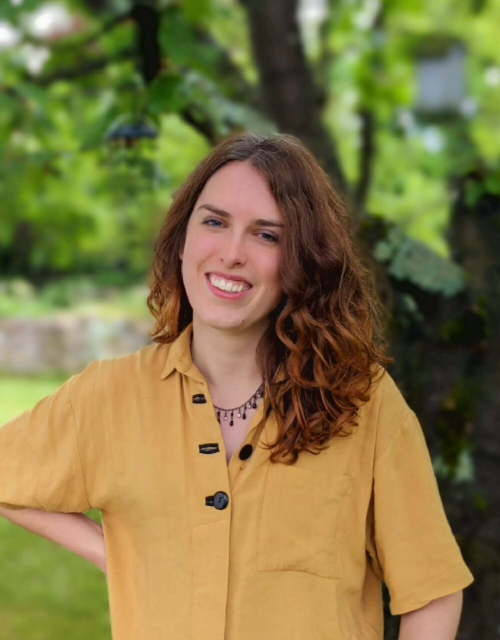
Maja Warlich
Institute of Geography
Research associates
Address
Contact
Consultation Hours
By appointment
Young Research Group: Geographies of Digital Infrastructures
I am part of the young research group "Geographies of Digital Infrastructures". Our project's topic is "Resiliance of Digital Infrastructure - Geopolitical Conflicts Surrounding Internet Routing", see NG Geographien digitaler Infrastrukturen for more information.
PhD project in Computer Science
My interdisciplinary PhD project is located in the intersection of Computer Science (Internet measurement, IT-security) and Geography (digital infrastructure, geopolitics). I analyse the impact that physical Internet infrastructure such as submarine fiber-optic cables, data centers, and interconnection facilities have on digital interconnection between networks, and what role economic strategies of private and state actors as well as geopolitical contexts play in data routing decisions.
Within my research, I use and extend on common Internet measurements techniques. Public, historic databases aid me in tracing routing decisions over time, which are partially reflected in traceroutes and Border Gateway Protocol (BGP) routing tables. By focussing on select pieces of infrastructure, I investigate the network topology arround it to understand the interplay between phyiscal and digital interconnection.
EllaLink serves as a case study for my PhD project. As the first - and, to date, only - fibre-optic cable carrying IP traffic between Europe and South America, it offers a chance to study changes in network proximity between two continents in as isolated a system as is possible within the incredibly interconnected global Internet.
Another aim of my PhD project is to create a threat model for state actors wanting secure, sovereign, and resillient digital connectivity even in times of crisis. As I have shown in my Master thesis "Towards a Threat Model for Satellite Internet in War Zones - Insights from the Russia-Ukraine War", classic threat models are perfected for systems on a much smaller scale than a whole country's connectivity, and ignore that sometimes, the security goals of a system's owner or operator aren't congruent with a system's user. Yet, state actors often rely on private and even foreign companies, tech giants, and sometimes individuals to secure connectivity for their people. With how ciritcal global, fast, and easily accessible connectivity is in times of peace as well as conflict, state actors must be equipped with the tools to to ascertain, analyze, prevent, and mitigate threats towards it - a threat model for Internet connectivity from a state actor's perspective.
Vorträge
- Spatial Politics of Internet Infrastructures: The Promise and Unintended Effects of the EllaLink Submarine Cable; Jahrestagung des AK Digitale Geographie 6.-7.11.2025 in Frankfurt am Main
Publikationen
- Warlich, Maja (2025): Reeling in Secrets: A Deep Dive into FinFisher Spyware. FIfF-Kommunikation, 2/2025, S. 7-12
Since 2025
Working Group "Resilienz digitaler Infrastrukturen – Geopolitische Konflikte um Internet-Routing", NG Geographien digitaler Infrastrukturen, FAU
2022 - 2025
M.Sc. Computer Science - "Towards a Threat Model for Satellite Internet in War Zones - Insights from the Russia-Ukraine War", Department of Computer Science, FAU
2024 - 2025
Head Delegate - "FAU Model United Nations (FAUMUN) Seminar", Department of Public and International Law, FAU
2018 - 2024
Part-Time Employee and Working Student - "Document & Configuration Management Professional", Research and Development, Siemens AG
2017 - 2022
B.Sc. Computational Engineering - "Implementation of Communication Schemes for the LB Method using Different Data Structures through Meta-Programming Techniques", Department of Computer Science, FAU