
Institute of Geography @ Friedrich-Alexander-Universität Erlangen-Nürnberg (FAU)
Institute of Geography @ Friedrich-Alexander-Universität Erlangen-Nürnberg (FAU)

Welcome to the Institute of Geography at FAU Erlangen–Nürnberg. Our institute is one of the leading centres for geographical research and teaching in Germany and part of an active international research community.
Located in Erlangen, the institute combines a long academic tradition with innovative research and internationally oriented study programmes.
Friedrich-Alexander-Universität Erlangen-Nürnberg is one of the largest and most research-intensive comprehensive universities in Germany. With strong links to industry, society and international research networks, FAU is known for its innovative research environment and interdisciplinary collaboration across the natural sciences, engineering, social sciences and humanities.
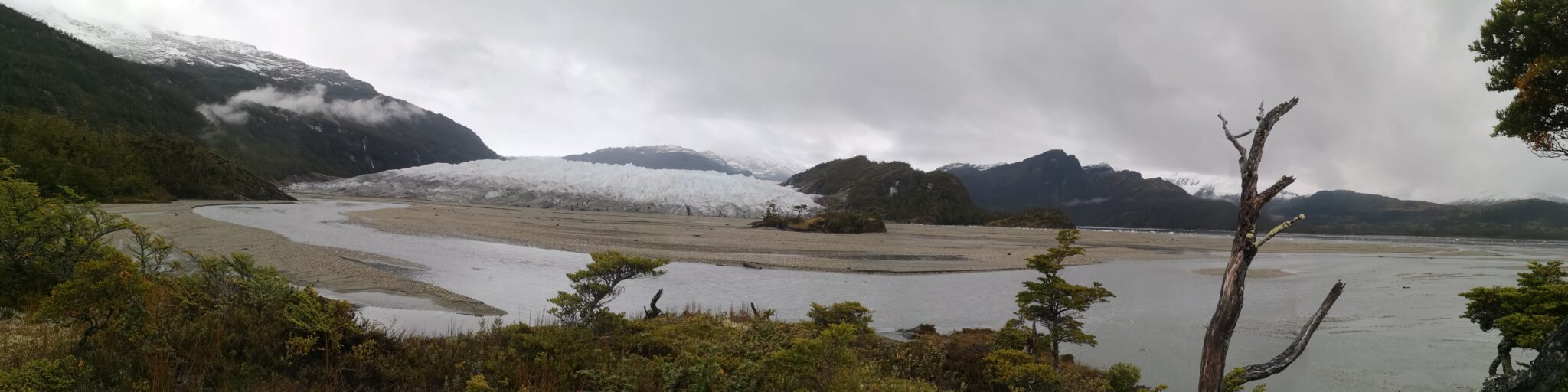
Our research connects social and environmental perspectives to address major global transformations. Key topics include climate and glacier dynamics, digital transformations, human–environment interactions, urban and regional development, and the spatial dimensions of inequalities and human rights.
Researchers at FAU Geography publish internationally and are highly successful in acquiring competitive research funding. The institute is strongly embedded in interdisciplinary collaborations across the social and environmental sciences.
Human / Cultural Geography
Research in Human Geography examines the social, political and technological transformations shaping contemporary societies and environments. We analyse how socio-technological transformations, environmental change and geopolitical tensions reshape societies, infrastructures and spatial relations across cities, regions and globally interconnected spaces.
Key topics include urban and regional transformations, the socio-spatial implications of geoinformation and digital technologies, human–environment interactions, and societal responses and adaptations to environmental change. By combining qualitative approaches with geodata-based methods and drawing on critical geographical perspectives, our research contributes to a deeper understanding of socio-environmental transformations and explores pathways towards sustainable and just futures.

Research Groups
- Cultural, Political and Digital Geographies – led by Georg Glasze
Research on cultural and political geographies, discourse and knowledge, geopolitics, and the spatial politics of digital transformations and geodata. - Society–Environment Research Group – led by Sandra Jasper
Research on human–environment relations, urban political ecology, environmental change, and the relationships between urban nature, biodiversity and human health. - Regional Development – led by Tobias Chilla
Research on regional development, spatial governance, regional economic transformation, and innovation in cities and regions. - Geoinformation & Society – led by Blake Walker
Research on geoinformation and society, geospatial data in social and environmental research, with applications in health and climate adaptation.
Physical Geography
Research in Physical Geography investigates environmental systems, landscape dynamics and global environmental change across a range of spatial and temporal scales. Our work focuses on the interactions between climate, ecosystems, soils and the cryosphere and contributes to understanding how environmental systems respond to natural variability and anthropogenic change.
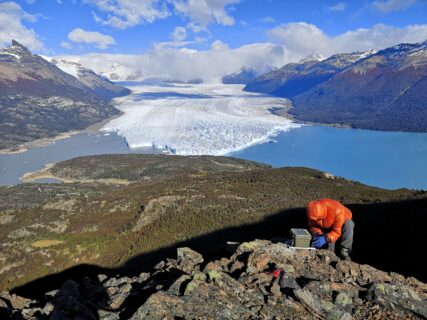
Research combines field-based environmental observation with geospatial analysis, remote sensing and environmental modelling. Particular strengths include internationally recognised research on glaciers and mountain climates, long-term environmental reconstruction using tree-ring records, and the analysis of soil and land-use dynamics.

Research Groups
Soil Science – led by Rupert Bäumler
Research on soil processes, soil erosion, land use dynamics and soil–water interactions.
Biogeography and Dendroecology – led by Achim Bräuning
Research on vegetation dynamics, dendrochronology (tree-ring research) and long-term environmental change.
Remote Sensing and GIS – led by Matthias Braun
Research on Earth observation, remote sensing, glacier monitoring and spatial analysis of environmental change.
Climatology – led by Thomas Mölg
Research on climate dynamics, mountain climates, glacier–climate interactions and the impacts of climate change.
Our degree programmes combine conceptual perspectives with strong empirical and methodological training. Teaching is closely connected to ongoing research and emphasizes fieldwork, critical thinking and interdisciplinary approaches.

We offer:
- BA Cultural/Human Geography (German-taught with selected English offerings for international guest students)
- BA Physical Geography (German-taught with selected English offerings for international guest students)
- MA Cultural/Human Geography (German-taught with selected English offerings for international guest students)
- MSc Physical Geography: Climate and Environmental Sciences (English-taught)
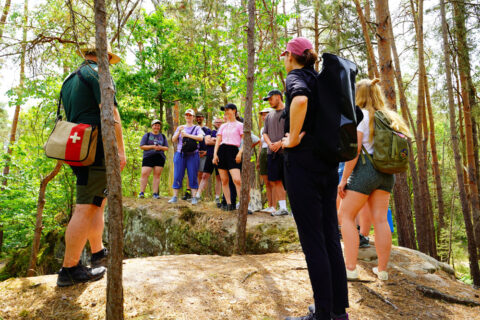
Field courses and excursions in Germany and abroad are a central part of geographical training at FAU.
Students benefit from close supervision, research-based teaching and opportunities to participate in research projects.twas Blindtext, den Sie ersetzen sollten.

The institute hosts international researchers and students and maintains collaborations with universities and research centres across Europe and worldwide. Teaching and research take place in an international academic environment, and many research projects involve international fieldwork and partnerships.
Geography has a long tradition in Erlangen: the first professorship in geography at the university was established in 1895, making Erlangen one of the longstanding centres of academic geography.
The institute is associated with important contributions to geographical thought, including the work of Walter Christaller, who developed the theory of central places while working in Erlangen. Erlangen is also linked to key milestones in the discipline’s development: here, Gudrun Höhl became the first woman to complete a habilitation in geography in the German-speaking world, with a study in urban and regional geography. Today, the institute is an internationally connected research environment with collaborations across Europe and beyond.
FAU is located in southern Germany, in the Nuremberg Metropolitan Region – the centre of northern Bavaria and one of Germany’s most dynamic research and innovation regions.
The university city of Erlangen hosts a vibrant academic environment with a large student population and major research institutions. With around 100,000 inhabitants and more than 30,000 students, Erlangen is a compact and highly livable university town known for its green spaces and bicycle-friendly infrastructure.
Nearby Nuremberg, a city of more than half a million inhabitants, is one of southern Germany’s most important economic centres and a major hub for industry, innovation and entrepreneurship. At the same time, the historic city actively engages with its complex past and today positions itself as a City of Human Rights, hosting numerous institutions and initiatives dedicated to human rights research and advocacy.
The surrounding region provides excellent opportunities for outdoor activities. The nearby Franconian Switzerland is well known for its distinctive landscapes and is a popular destination for hiking, climbing, mountain biking and canoeing.
Together, Erlangen, Nuremberg and the surrounding region offer an attractive academic environment with strong international connections and a high quality of life.