
YRG Geographies of Digital Infrastructures
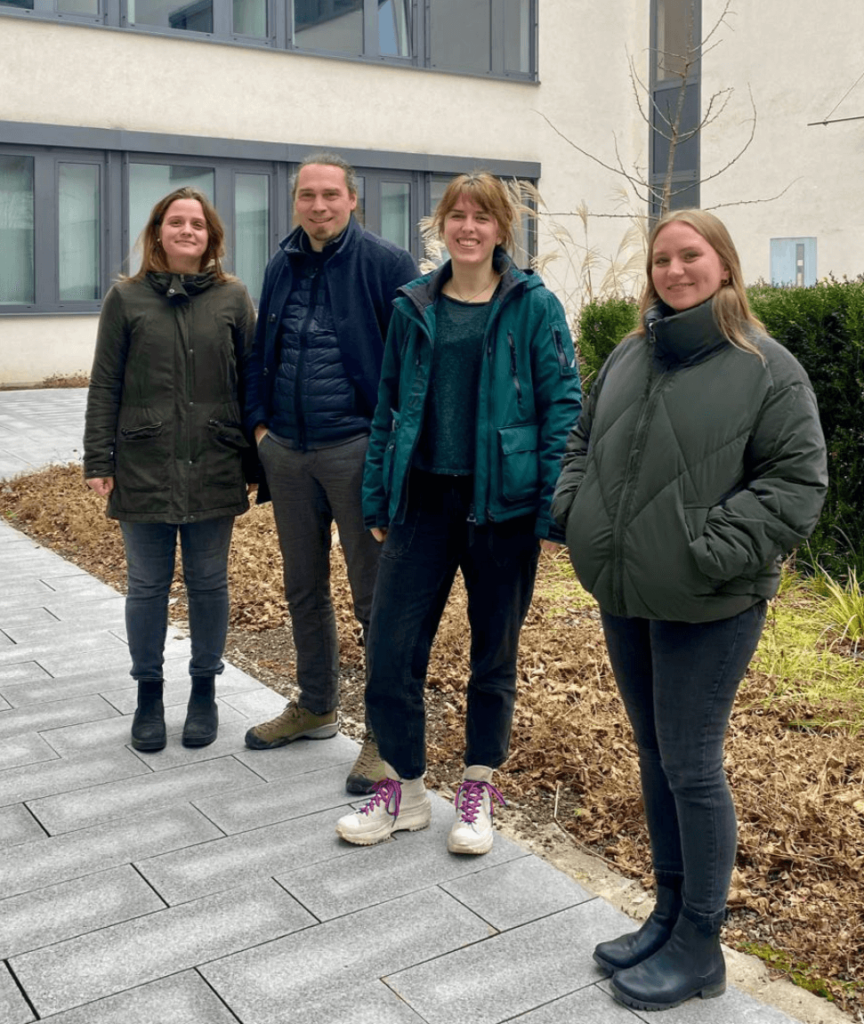
The young research group focuses on an often invisible material geography of our increasingly digitalised world: digital infrastructures and their embedding in geopolitical tensions and conflicts. In order to research the resilience of digital infrastructures, the security of internet routing and new and emerging dependencies, the junior research group is developing an interdisciplinary connection between digital geography, GIScience and IT security research – and applying it to benefit international peace and conflict research as well as critical infrastructure research.
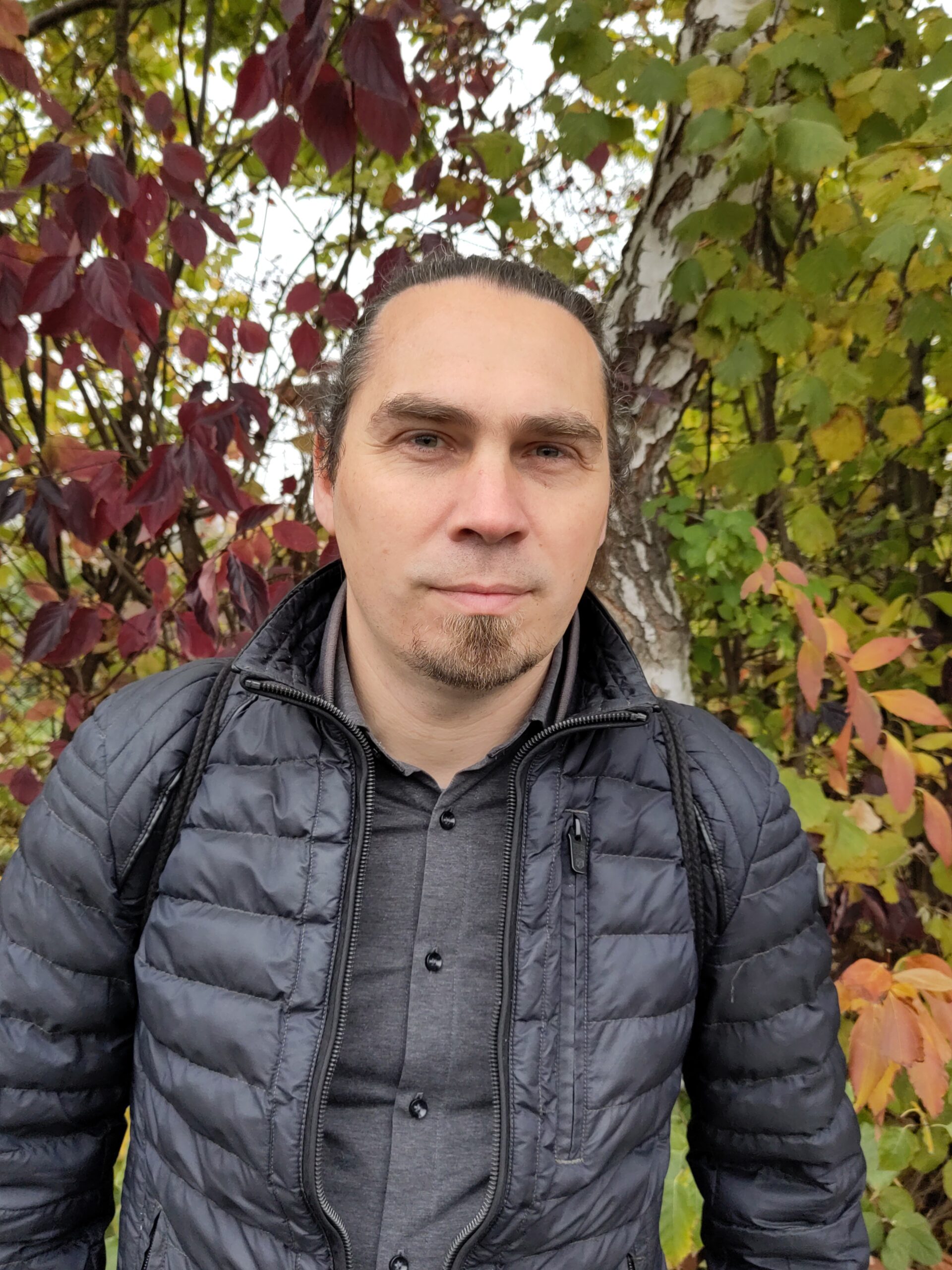
Dr. Finn Dammann
Research associates
Contact

Josephine Brandenburg
Research associates
Contact

Maja Warlich
Research associates
Contact
The research project, which has been funded by the BMBF since 1 October 2024, addresses a research gap in the scientific debate on Internet infrastructures: The implications of geopolitical conflicts and tensions on the routing of data packets via IP and on the resilience of digital infrastructures have so far remained largely outside the field of vision of information technology and social science research on digital communication systems. However, the effects of geopolitical conflicts on providers of basic Internet infrastructures – such as Internet service providers, interconnection service providers or providers of content delivery networks – have repeatedly become apparent in recent years: In the trade conflict between the USA, China and the EU, in Russia’s war against Ukraine or currently in the war in Israel and Gaza, providers and operators of digital infrastructures are increasingly appearing as actors that have a direct influence on geopolitical tensions and conflicts. As part of the junior research group, the project develops an interdisciplinary context for researching the implications of geopolitical conflicts on the resilience of digital infrastructures, the IT security of internet routing and the newly emerging dependencies of providers of basic internet infrastructures – and uses three empirical case studies on current geopolitical tensions to make these fruitful for peace and conflict research as well as for German and European digital policy.
The young research group follows up on a start-up project for innovative research topics by Finn Dammann, which was funded by the Bavarian Institute for Digital Transformation (bidt) as part of a separate position from November 2022 to April 2023.
Governing Digital Circulation in Germany and Europe
Who controls the circulation of digital data and information, how and with what objectives? This question is a central subject of numerous debates in science and politics. The term ‘digital sovereignty’ is often used to problematise social dependence on globally active digital companies. This research project examines which political ‘digital’ geographies are produced linguistically-discursively and technically-materially.
Understanding Changes in Digital Knowledge Production
Digital technologies are also associated with new forms of organisation, collection, processing and presentation of geographical knowledge. In open map projects (Volunteered Geographic Information) such as OpenStreetMap, thousands of users voluntarily and consciously produce geodata for a shared database. We are researching the effects of social inequalities, economic interests and traditional cartographic epistemes on forms of collaborative geographical knowledge production.
Methods and Innovations in Geography
The digital transformation offers geography in particular new opportunities and impulses for the further development of its research processes and methodologies. At the interface between digital geography, critical cartography and platial GIS, we are working on new and alternative forms of spatial data analysis and geovisualisation.
We are not currently advertising any specific topics, but are happy to receive enquiries from the field of digital infrastructures.
Theses mentored in the past:
- Robin Blum (2025): “Diálogo es la ruta” – Potentiale zivilgesellschaftlicher Einflussnahme auf den Friedensprozess in Kolumbien am Beispiel des ACVC (bachelor thesis)
- Frank Patrick (2025): Deutschland auf dem Weg zur Gigabitgesellschaft – Breitbandausbau als Grundlage der Digitalisierung im ländlichen Raum (master thesis)
- Lorenz Rickert (2025): Heimat als politischer Begriff – Naturschutz und Landschaftsbilder im Heimatdiskurs mit Fokus auf der AfD (bachelor thesis)
- Helena Hoffmann (2024): Erst unsichtbar dann unübersehbar: Die Nord Stream Pipelineinfrastruktur im Kontext des Russland-Ukraine Krieges (bachelor thesis)
- Maria Geißler (2024): From Hashtag to Haircuts: digitale Solidarität mit der iranischen Frauenbewegung. Eine Instagram-Analyse der Solidarität in Deutschland (bachelor thesis)
- Jan Pereira de Carvalho (2024): Multidimensionale Territorialität während der COVID-19 Pandemie am Klinikum Nürnberg-Nord (Zulassungsarbeit – co-mentorship)
- Sophia Christa (2023): Geopolitisierung erneuerbarer Energien in Deutschland vor dem Hintergrund des Russland-Ukraine-Kriegs (bachelor thesis – co-mentorship)
Publications
- Georg Glasze, Amaël Cattaruzza, Finn Dammann and Frédérick Douzet (Hrsg., due early 2026 – open access): The Elgar Companion to the Geopolitics of Digital Sovereignty. Contested Networks, Territories and Self-determination. Edward Elgar Publishing. Georg Glasze, Amaël Cattaruzza, Finn Dammann and Frédérick Douzet: Political Geographies of Digital Sovereignty – An introduction to the Book
- Finn Dammann: Situating digital sovereignty in the material geographies of internet infrastructures. Lessons from Mediterranean interconnection hubs
Georg Glasze, Finn Dammann, Amael Cattaruzza, Frederick Douzet & Daniel Lambach: Contested spatialities of the digital – Conceptual contributions from geography - Schröder-Bergen, S., Michel, B., Glasze, G., & Dammann, F. (2025). Open Geospatial Data within Digital Capitalism: OpenStreetMap and the Overture Maps Foundation. Cartographica: The International Journal for Geographic Information and Geovisualization. https://utppublishing.com/doi/10.3138/cart-2024-0030
Pablo Abend, Finn Dammann & Boris Michel (2025): Kritische Infrastrukturspaziergänge in datafizierten Welten. In: Naumann, Matthias & Strüver, Anke (Hrsg.), Handbuch Mobile Methoden in der Sozial- und Raumforschung, UTB (Open Access) - Boris Michel & Finn Dammann (2024). Breakdowns, (Un-)Sichtbarkeiten und glitches. Kritische Geographien der Resilienz digitaler Infrastrukturen. Geographica Helvetica, 79(4), 311–323. https://doi.org/10.5194/gh-79-311-2024
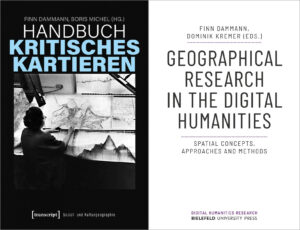
- Finn Dammann & Dominik Kremer (Eds): Geographical Research in the Digital Humanities. Spatial Concepts, Approaches and Methods. Reihe: Digital Humanities Research. [transcript] Bielefeld University Press (2024, Open Access)
- Finn Dammann & Dominik Kremer, D. (2024): Spatial Concepts, Approaches and Methods for Digital Humanities – An Introduction to the Book. In: F. Dammann & D. Kremer (Eds), Geographical Research in the Digital Humanities. Spatial Concepts, Approaches and Methods (pp. 7-11). [transcript] Bielefeld University Press
- Finn Dammann & Georg Glasze (2023): Politische Geographien der digitalen Transformation – Von der „globalen Informationsgesellschaft“ zur „digitalen Souveränität“, In: Martin Doevenspeck & Gabriele Schrüfer (Hrsg.): Konflikte, Bayreuther Kontaktstudium Geographie, Band 12, S. 1-21
- Finn Dammann (2023): Politische Geographien der digitalen Transformation – Umkämpfte Raumproduktionen vor dem Hintergrund der Politiken einer „Digitalen Souveränität“ in Deutschland, Friedrich-Alexander-Universität Erlangen-Nürnberg (FAU), Naturwissenschaftliche Fakultät (veröffentlichte Rahmenschrift der kumulativen Dissertation, open access)
- Georg Glasze, Frédérick Douzet, Amaël Cattaruzza, Finn Dammann (2023): Introduction: The Emerging Geopolitics of Data. In: Contested Spatialities of Digital Sovereignty. Geopolitics, https://doi.org/10.1080/14650045.2022.2050070 (open access)
- Georg Glasze, Finn Dammann, Max Münßinger, Didier Danet, Clotilde Bômont, Alix Desforges (2023): Reception and Elaboration of “Digital Sovereignty” in Three European Discourse Arenas: France, Germany, and the EU. In: Contested Spatialities of Digital Sovereignty. Geopolitics, https://doi.org/10.1080/14650045.2022.2050070 (open access)
- Jan Winkler & Finn Dammann (2023): Digitally Competent – Digitally Sovereign – Digitally Civic: geopolitics of Subject Formation in the German Context. In: Contested Spatialities of Digital Sovereignty. Geopolitics, https://doi.org/10.1080/14650045.2022.2050070 (open access)
- Finn Dammann & Boris Michel (Hg.): Handbuch Kritisches Kartieren. 2022, transcript (Leseprobe unter https://www.transcript-verlag.de/media/pdf/9f/e4/6b/ts5958_15VnFoRECbBf7u.pdf)
- Finn Dammann & Boris Michel (2022): Kritisches Kartieren – zur Einführung. In: Finn Dammann & Boris Michel (Hg.): Handbuch Kritisches Kartieren. transcript, S. 9-21
- Finn Dammann & Georg Glasze, G. (2022): Governing digital circulation: The quest for data control and sovereignty in Germany. Territory, Politics, Governance, https://doi.org/10.1080/21622671.2022.2141850
- Finn Dammann & Georg Glasze (2022): „Wir müssen als Deutsche und Europäer unsere digitale Souveränität zurückgewinnen!“ Historische Rekonstruktion und internationale Kontextualisierung der Diskurse einer „digitalen Souveränität“ in Deutschland. In G. Glasze, E. Odzuck, & R. Staples (Eds.): Was heißt digitale Souveränität? Diskurse, Praktiken und Voraussetzungen »individueller« und »staatlicher Souveränität« im digitalen Zeitalter, transcript, S. 29-60. (open access)
- Finn Dammann, Christian Eichenmüller & Georg Glasze (2022): Geographies of “digital governmentality”: Platform-based governing through adaptive environments. Digital Geography and Society, 3, 100034. https://doi.org/10.1016/j.diggeo.2022.100034 (open access)
- Julia Pohle, Leo Thüer, Finn Dammann & Jan Winkler (2022.): Das Subjekt im politischen Diskurs zu „digitaler Souveränität“. In: Norbert Kersting, Jörg Radtke, Sigrid Baringhorst (Hg.): Handbuch Digitalisierung und politische Beteiligung. Luxemburg: Springer Verlag. (open access)
- Finn Dammann & Boris Michel (2022): Digitale Ungleichheiten überwinden – kritisches Kartieren crowdbasierter Wissensproduktionen. In: Finn Dammann & Boris Michel (Hg.): Handbuch Kritisches Kartieren. transcript.
- Finn Dammann, Iris Dzudzek, Georg Glasze, Annika Mattissek & Henning Schirmel (2021): Verfahren der lexikometrisch-compterlinguistischen Analyse von Textkorpora. In: Georg Glasze & Annika Mattissek (Hrsg.): Handbuch für Diskurs und Raum. Theorien und Methoden für die Humangeographie sowie die sozial- und kulturwissenschaftliche Raumforschung, 3. Aufl., transcript, Bielefeld, S. 313-343
- Georg Glasze, Finn Dammann & Lea Bauer (2021): Wissen durch Karten. In: Tabea Bork-Hüffer; Henning Füller; Till Straube (Hrsg.): Handbuch Digitale Geographien, Welt – Wissen – Werkzeuge. utb.
- Finn Dammann & Georg Glasze (2021): Regieren und Steuern. In: Tabea Bork-Hüffer; Henning Füller; Till Straube (Hrsg.): Handbuch Digitale Geographien, Welt – Wissen – Werkzeuge, 2021
- Susanne Schröder-Bergen, Georg Glasze, Boris Michel & Finn Dammann (2021): De/colonizing OpenStreetMap? Local mappers, humanitarian and commercial actors and the changing modes of collaborative mapping. GeoJournal. https://doi.org/10.1007/s10708-021-10547-7
- Georg Glasze & Finn Dammann (2020): Von der ›globalen Informationsgesellschaft‹ zum›Schengenraum für Daten‹ – Raumkonzepte in der Regierung der ›digitalen Transformation‹ in Deutschland. In: Thomas Döbler; Christian Pentzold; Christian Katzenbach (Hrsg.): Räume digitaler Kommunikation, Halem. S. 159-182
Talks & Lectures
- Spatial Politics of Internet Infrastructures: The Promise and Unintended Effects of the EllaLink Submarine Cable; Jahrestagung des AK Digitale Geographie 6.-7.11.2025 in Frankfurt am Main (Vortrag von Maja Warlich)
- Sociotechnical imaginations of internet infrastructures: Insights from southern European centres of digital infrastructure development (06.11.2025-07.11.2025), conference of the Digital Geography Working Group in Frankfurt am Main. (Presentation by Josephine Brandenburg
- Interconnection Hubs, Content Delivery Networks and Emerging AI Infrastructures. Insights into the material geographies of „digital ecosystems“ in the Western Mediterranean, Internationale Jahrestagung der Royal Geographical Society, 26. – 29. August in Birmingham (Posterpresentation by Josephine Brandenburg & Finn Dammann)
- Spatial Politics of Internet Infrastructures: Connecting, Bypassing, Territorializing, Internationale Jahrestagung der Royal Geographical Society, 26. – 29. August in Birmingham (Presentation by Dr. Finn Dammann with Prof. Dr. Boris Michel MLU Halle-Wittenberg)
- Geopolitics of digital sovereignty in global comparison, Panel auf dem Annual Symposium of the Digital Geography Research Group, 19. – 20.06.2025 (federführend organisierter Panel von Finn Dammann) Situating digital sovereignty in the material geographies of internet infrastructures. Lessons from Mediterranean interconnection hubs (Presentation by Finn Dammann)
- The Race for LEO. Fragmented Futures of Satellite Internet (Prensentation by Maja Warlich)
- Interconnection Hubs, Content Delivery Networks und neu entstehende KI-Infrastrukturen – Einblicke in die materiellen Geographien des digitalen Kolonialismus im westlichen Mittelmeerraum, Tagung des AK Politische Geographie 22.–24. Mai 2025 in Freiburg (Presentation by Finn Dammann & Josephine Brandenburg)
- Data Mobilities and the Material Geographies of Internet Infrastructures. T2M Annual Conference – Mobilities and Infrastructures: Transitions and Transformations (23. – 25.09.2024 in Leipzig, Vortrag gemeinsam mit Boris Michel)
- Interconnection Hubs, Content Delivery Networks & Submarine Cables – Implikationen geopolitischer Konflikte auf Internet-Routing und die Resilienz digitaler Infrastrukturen, 10. Juli 2024, Kolloquium am Institut für Geographie der FAU (Vortrag zur Eröffnung des Habilitationsverfahrens)
- Politische Geographien digitaler Infrastrukturen – Implikationen geopolitischer Spannungen und Konflikte auf Internet-Traffic, Fränkisch Geographische Gesellschaft, 11. Dezember 2023 (Vortrag)
- Politische Geographien der digitalen Zirkulation – Umkämpfte Raumkonfigurationen von Content Delivery Networks, Deutscher Kongress für Geographie, 22. September 2023 (Vortrag zusammen mit Boris Michel)
- Towards a Political Geography of the Digital Transformation. Workshop: Digital Geographic Movements and Methods, June 21-23, 2023 in Calgary, Alberta, Canada (Vortrag mit Georg Glasze)
- Political Geographies of Digital Infrastructures – Contested spaces of Content Delivery Networks, Session: Toward a Genealogy of Global Infrastructure: Histories, Temporalities, Ruptures. AAG Annual Meeting 2023 (Vortrag mit Boris Michel am 24.03.2023, hier geht es zum Abstract)
- Governing digital flows. Towards a digital geography of circulation. Digitale Geographien – Räume digitaler Zukünfte, 17. – 18. November 2022, Halle (Vortrag mit Boris Michel)
- AI in OpenStreetMap. A New Form of Data Colonialism? AAG Annual Meeting, 2021 (Vortrag mit Georg Glasze & Susanne Schröder-Bergen (Vortragende) und Boris Michel)
- “Colonizing of the crowd? Crowd-based geo-data production and urban platform capitalism.” Online Symposium Platform Urbanism Towards a technocapitalist transformation of European cities?, 2021 (Vortrag mit Boris Michel & Susanne Schröder-Bergen (Vortragende) und Georg Glasze)
- Kritische Kartographie zwischen postkolonialer Kritik und dekolonialer Praxis. Workshop „Mit offenen Karten. Kartografie und die Kritik daran.“, Online an der Universität Kassel, 2021 (Fortbildungsvortrag mit Boris Michel)
- Das „digital souveräne“ Subjekt. Konstitutionsmomente einer Subjektivierungsform im Regieren der digitalen Transformation. Neue Kulturgeographie, Technocultures & Technoscapes, 2020, Bonn (Vortrag mit Jan Winkler)
- „Wir müssen unsere digitale Souveränität zurückgewinnen!“ Eine Renaissance von territorialer Souveränität im Digitalisierungsdiskurs? Deutscher Kongress für Geographie 2019, Kiel (Vortrag mit Georg Glasze)
- „As Germans and Europeans, we must regain our digital sovereignty“ – a renaissance of geopolitical thinking in the problematisation of the digital tansformation? Conference paper for the Workshop of Extraterritoriality of Data, Tallin, 2019 (Vortrag mit Georg Glasze)
- „Deutschland muss seine digitale Souveränität verteidigen“ Der Einzug territorial-geopolitischen Denkens in die Konfigurierung der digitalen Transformation – eine Analyse politischer Rationalitäten. Workshop of the working group for political geography, Münster, 2019 (Vortrag mit Georg Glasze)
- Der „digital souveräne Staat“? Konflikte um die Produktion von Wissen zu Bevölkerung und Territorium. Workshop zu Globalisierung und Digitalisierung – (neue) Weltbezüge der Geoinformation, 2018, Jena (Vortrag mit Georg Glasze)
- Datenarmut im Zeitalter von „Big Data“? Oder: welche Rolle können Datenzentren an Universitäten für Lehre und Forschung der Sozialwissenschaften spielen? Interdisziplinärer Workshop: Das Ende der Theorie? Big Data in der Forschung (10.-11. Oktober 2017 – Orangerie, Erlangen, Vortrag zusammen mit Georg Glasze)
- Die Debatte um „Digitale Souveränität“ in Deutschland. Zwischen Regierungsrationalitäten der territorialen Abgrenzung und des neoliberalen Wettbewerbs. Deutscher Kongress für Geographie, 2017, Tübingen (Vortrag mit Georg Glasze)
- Forschung mit und über Geodaten in der Kulturgeographie. Kolloquium am Institut für Arbeitsmarkt- und Berufsforschung (IAB), Nürnberg, 2017 (Vortrag mit Georg Glasze)
- Language geography in OpenStreetMap – A geolinguistic analysis. Annual Meeting of the AAG (Association of Amercian Geographers), Boston, 2017 (Vortrag)
Projects/Workshops/Sessions
- Workshop: Neue Ansätze kritischer Geovisualisierung, Halle (Saale), 08. bis 10. Mai 2025 (Organisation zusammen mit Boris Michel, Pablo Abend, Nora Küttel, Lea Bauer, Francis Harvey & Anna Unterstab)
- Jahrestagung AK Digitale Geographien: “Geospatial Worlds: Geodaten, Code & Gesellschaft”, Erlangen-Nürnberg, 30. September bis 02. Oktober 2024 (Organisation zusammen mit Blake Walker, Georg Glasze und Studierenden im MA Kulturgeographie, hier geht es zum Rückblick)
- Workshop Neue Ansätze kritischer Geovisualisierung, 25. – 27. April 2024 in Halle (Organisation zusammen mit Boris Michel, Pablo Abend, Nora Küttel, Lea Bauer und Francis Harvey, hier geht es zum Call)
- Workshop zu Geographien von „Open Collaboration“ und „Digital Commons“, 7./8. Dezember 2023 in Erlangen (Organisation zusammen mit Thilo Lang, Georg Glasze & Boris Michel, hier geht es zum Call)
- Session zu „Geopolitisierung digitaler Infrastrukturen“, Deutscher Kongress für Geographie 2023, Frankfurt a. M. (Leitung zusammen mit Daniel Lambach & Georg Glasze, hier geht es zum Call)
- 6th Annual Humanitarian Mapathon – Wedn., 19th of April, 2023 (Co-Organisation für den Standort Erlangen zusammen mit Blake Walker, Dominik Kremer und Georg Glasze, hier geht es zum Programm )
- Konzeption und Prototypenbau eines Web 2.0 Kartographie Moduls für das Science Center Experimenta in Heilbronn (Projekt mit Georg Glasze; Mittel über Jochen Hunger Museum & exhibition design)
- Tagung „Räume digitaler Zukünfte“, Halle, 16.-18.11.2022. Moderation: Paper-Session zu „Digitalisierung als Werkzeug“. (Programm – Organisation: Leonie Büttner, Yannick Ecker und Boris Michel )
- Session zu Political Geographies of Data – Exploring digital territories, sovereignties and borders. International Geographical Union – UGI-IGU Paris – 18-22 July 2022 (mit Amaël Cattaruzza & Georg Glasze, https://www.geographie.nat.fau.de/files/2021/12/call-for-participation-political-geographies-of-data-igu-2022.pdf)
- Workshop zum Kritischen Kartieren sozialer Wirklichkeiten – Neue Formen und Ansätze kartographischer Wissensproduktion, Martin-Luther-Universität Halle-Wittenberg, 28.‐30.04.2022 (zusammen mit Pablo Abend, Lea Bauer, Francis Harvey, Nora Küttel & Boris Michel, Programm)
- Humangeographische Sommerschule „Digitale Geographien“, September 2021 (Organisation zusammen mit Georg Glasze, Blake Walker, Dominik Kremer und Studierenden im FAU Masterstudiengang Kulturgeographie, Programm)
- Workshop Geography meets Digital Humanities – Neuere Ansätze raumbezogener Modellierung, Digital, 2021 (Workshop zusammen mit Dominik Kremer, Workshop Geography meets DH – Programm)
- Technologie, Gesellschaft und Raum im Reden über das „digitale Zeitalter“, 2017, Erlangen (Workshopsorganisation mit Boris Michel) Workshop Technologie, Gesellschaft und Raum – Programm
Other publications
- Ungleich und umkämpft – Content Delivery Networks als kritische Infrastrukturen (Blogbeitrag, 20. Oktober 2023, Bayerisches Forschungsinstitut für Digitale Transformation, hier geht es zum Beitrag)
- Sprachgeographie in OpenStreetMap – Eine geolinguistische Metadaten-Analyse, 2016 (Unveröffentlichte Masterarbeit)
News:
Coming Soon: Interdisciplinary Workshop “New Approaches to Critical Geovisualisation 2026”

22.04.2026 – From 4 June 2026 to 6 June 2026, the transdisciplinary workshop “New Approaches to Critical Geovisualisation 2026” will take place once again this year at Burg Giebichenstein University of Art and Design in Halle.
For the third year running, geographers, media scholars and artists will discuss the latest techniques and methods of critical mapping and present current (research) work in the fields of counter-mapping, Platial GIS, place-based GIS and spatial humanities. The workshop is once again organised by Pablo Abend, Anna Unterstab (both from Burg Giebichenstein University of Art and Design), Boris Michel (University of Halle), Nora Küttel (University of Bremen), Lea Bauer, Francis Harvey (both from IfL) and Finn Dammann (FAU Erlangen-Nuremberg).
We look forward to receiving your registrations by 30 April 2026 via the following link: https://docs.google.com/forms/d/e/1FAIpQLSdLaUh2sThxHwpz35xBr8AQkaTHpGO9K5zPwIlJBMmo3XHIOQ/viewform
The provisional programme can be found here.
Review: Annual Conference of the Working Group on Digital Geography
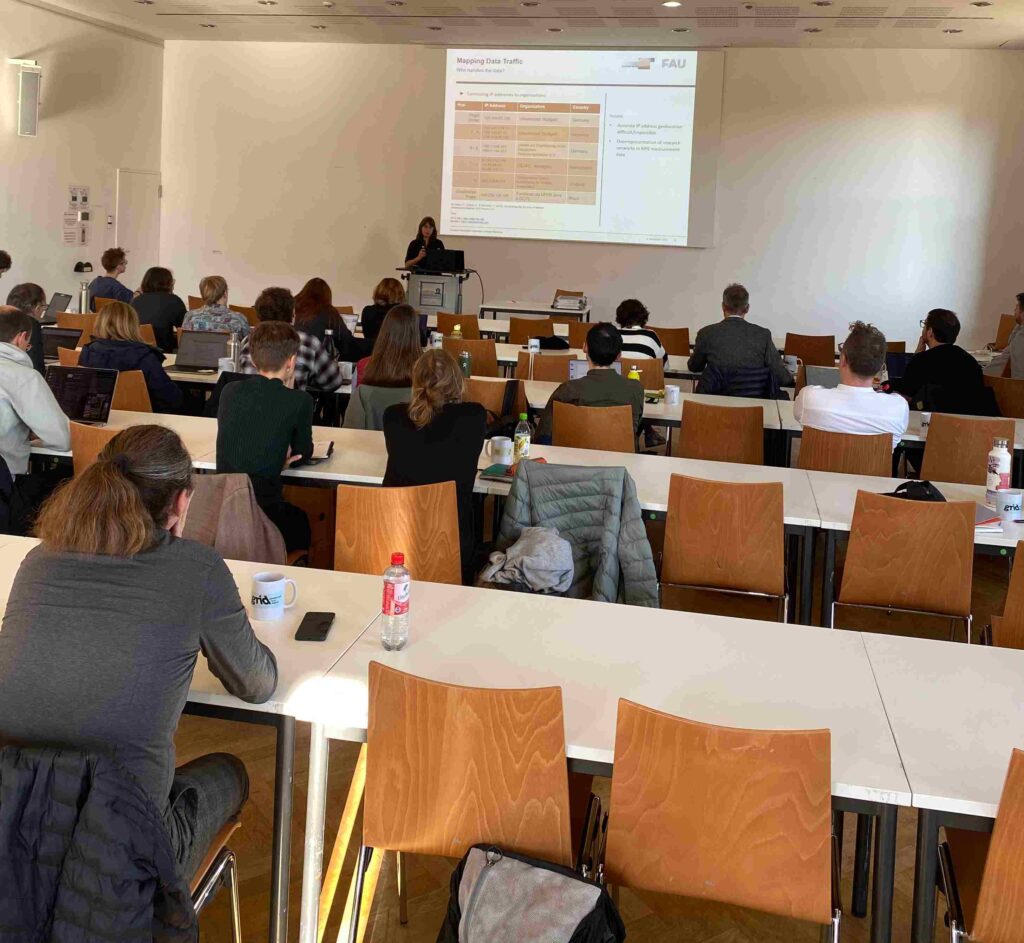
10.11.2025 – At the beginning of November, the annual meeting of the Working Group on Digital Geography took place in Frankfurt am Main. Under the theme “Digital geographies of valuation: platforms, technologies, narratives,” our young research group contributed two presentations in the session on Politics of digital infrastructures. As the final conference of the year, the meeting was a great opportunity to gain new inspiration for our research project. We would like to express our sincere thanks to the organizers.
Review: Status Conference of the BMFTR in Bonn
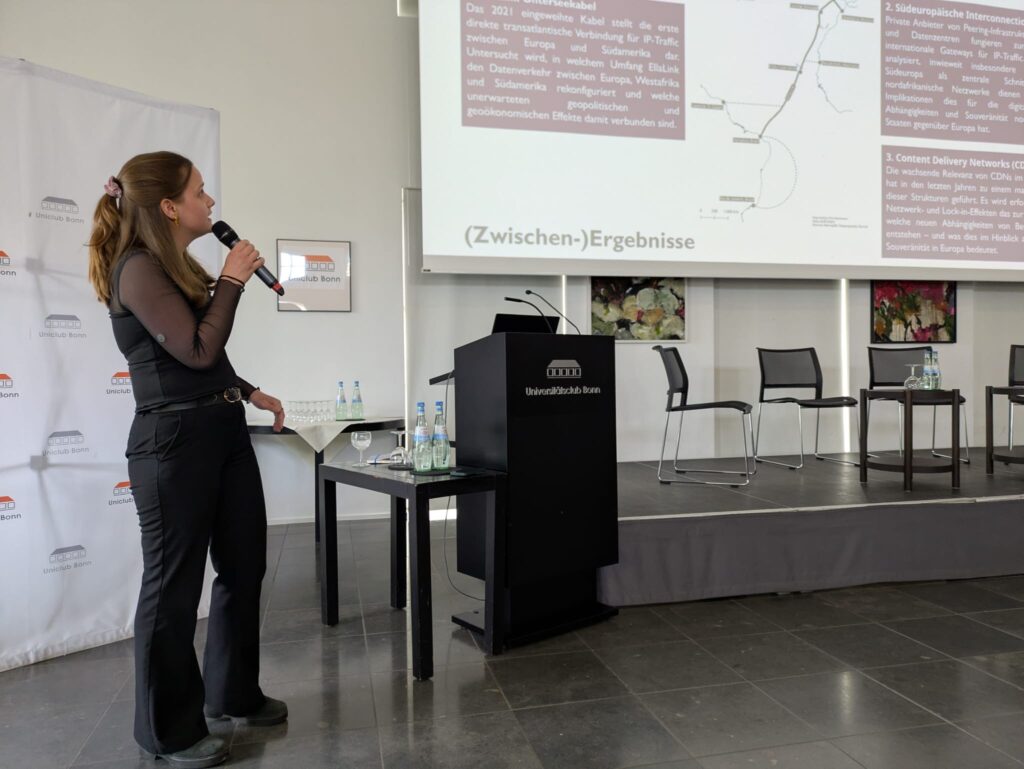
10.11.2025 – At the beginning of November, the Federal Ministry for Technology and Space invited participants to this year’s status conference of the funding line “Early-Career Research Groups in Scientific and Technical Peace and Conflict Research with a Focus on Arms Control.” Through poster presentations, the young research groups were able to showcase their respective projects and present initial interim results. The exchange across various disciplines gave us the opportunity to present and discuss our project with a transdisciplinary audience for the first time. Many thanks to the DLR project managers and the BMFTR for the productive exchange.
Save the Date: 17. November – Book presentation “Geopolitics of Digital Sovereignty”

20.10.2025 – On November 17, we will present our new book „The Elgar Companion to the Geopolitics of Digital Sovereignty“ together with colleagues from the FAU and the Parisian research group „Geopolitics of the Datasphere“ in the Orangerie in Erlangen. The volume will be published in the spring of 2026 by Georg Glasze, Amael Cattaruzza, Finn Dammann and Frederick Douzet. For further infos, see the website and the flyer.
Review: International Annual Conference of the Royal Geographical Society in Birmingham
03.09.2025 – Three days full of exiting presentations and new inspirations are now behind us.
On day one Finn Dammann (FAU Erlangen-Nuremberg) and Boris Michel (MLU Halle-Wittenberg) provided insights into their research on “Geographies of Interconnection Hubs and their geopolitical embeddings.” In their presentation, they demonstrated the multi-scalarity of Internet structures and their historical embedding in diverse geopolitical contexts of transport structures using material geographies of interconnection hubs in Southern Europe and the Philippines.
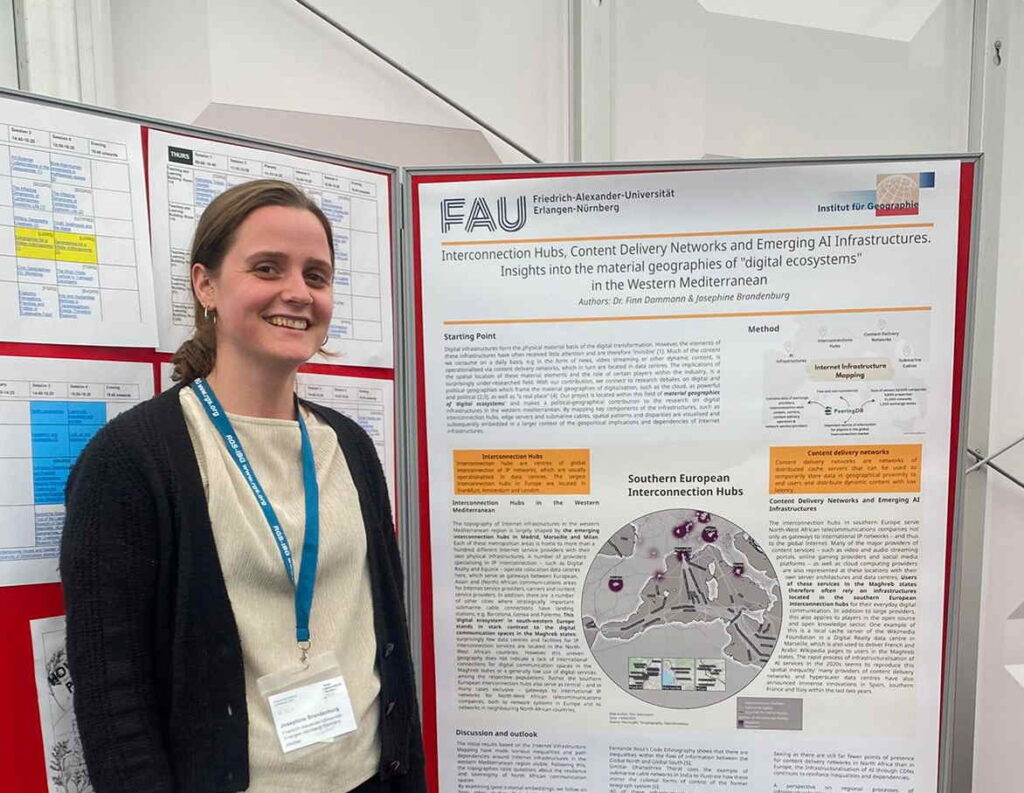
Our poster on the topic “Interconnection Hubs, Content Delivery Networks and Emerging AI Infrastructures. Insights into the material geographies of “digital ecosystems” in the Western Mediterranean” was also given a prominent place at the conference venue and facilitated a lively exchange on the topic of digital geographies.
In summary, we are delighted with the exciting discussions we had, the great contacts we made, and the interesting input we were able to take away from the RGS!
For all our posts, see our news archive.